Journal

  • What 365 Days Taught Me in About Ten

    What 365 Days Taught Me in About Ten

    In December 2024, I started a 365-photo project.

    I wanted to take one photo a day, post it here, for a year, and get intimate with my gear.

    I believe that until the day we die, our only job in life is to find out who and what we are about in all our endeavors. Here, it was to discover what kind of photographer I am.

    I made it about ten days because… I’m a geek.

    For far too many years, in one way or another, I have been writing about technology. I’m good at it … and in this project, it killed me.

    In my previous post, I started writing about all the technical things that popped up in my environment. I figured I had to deal with them, so I did what I was good at and started with all the details of what went wrong.

    The problem is, going down the documentation rabbit hole felt too comfortable and pulled me away from the project’s purpose. Which it did.

    Suffice it to say, the technology I was using was an unmitigated mess I didn’t want to deal with … so I didn’t.

    While that mess sat there, the project evolved, but I didn’t have time to fix any of the technology… until recently. I’m not going to document that because I don’t need to publicly self-flagellate about that… there are… other things I can self-flagellate about. 😁

    Over the past 2 years or so, I’ve done a lot of creative work. I’ve explored new things and returned to modern implementations of things I did a billion years ago.

    All of which are really challenging yet thrilling. I was washed in a sea of newness and rediscovery.

    I took Super 8 and 16mm film classes and rediscovered my love of film. I shot A Day at Benmarl on Super 8 Kodak Ektachrome and hand-processed it myself in a Lomo tank.

    After remembering what a nightmare that was, I discovered Vintage Visual and the AGO processor. I’ve since returned to regularly shooting and developing 35mm black-and-white stills. Soon, I’ll venture into other 35mm processes and Super 8 processing.

    Next, I want to study with a fine-art photographer. That, I think it the real next step in discovering who I am as a photographer.

    And this is all just part of the filmmaking and photography. I haven’t even talked about all my writing… Which is a whole other long-winded chat.

    Suffice it to say, I’m officially closing the previous 365 project. I’ll keep the old stuff around, but there’s going to be something new going forward. I’m not quite sure what yet, but to get there. I’ve got to complete this particular circle.

    With any project, just because it didn’t end how you initially envisioned doesn’t mean it wasn’t a success. Sometimes those fits and starts are there to move you along to your next stop.

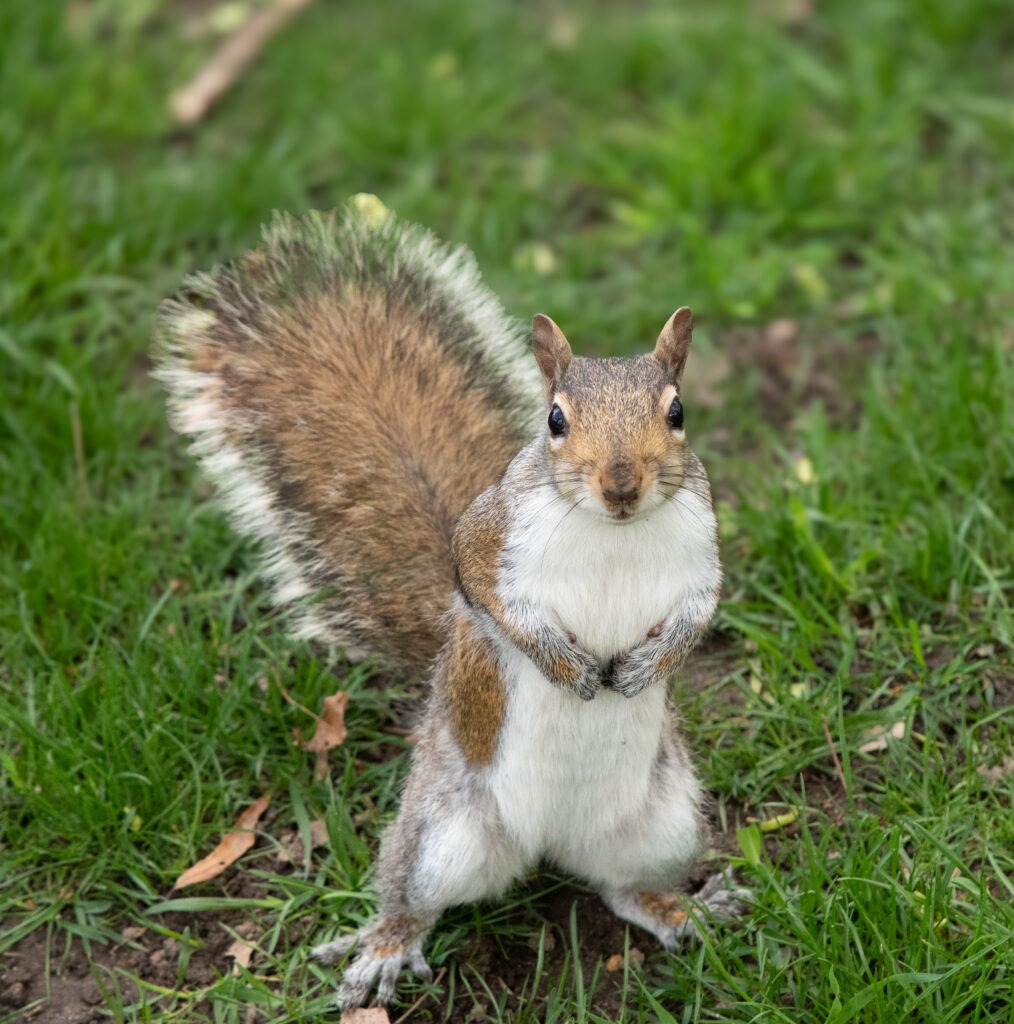
    So, for now, I’ll leave you with a portrait from a session I had in Central Park a few years ago.

    Peace.
  • The Super, Amazing World of Data Management – Part 1

    The Super, Amazing World of Data Management – Part 1

    Over the past ten years, I’ve taken somewhere in the neighborhood of 54,000 pictures and videos on various devices.

    That’s not a lot, considering I haven’t done much in the past 5 or 6 years.

    Nevertheless, it’s about a terabyte and a half of data that has to be managed.

    Now, it seems obligatory for those of us who have been around since before home computers, the internet, and the plethora of devices we now have that we must inevitably have an old guy or gal moment when we say the equivalent of “back in my day” …

    This one I actually find fascinating when I think about it.

    In the mid-90s, I interviewed for a job at a disaster recovery company. The company was located on North Broad Street in Philadelphia, in a building built during the Second World War. They stored tanks on the upper floors of the building because it could withstand massive air bombings.

    The guy takes me on a tour of their facility, and in one room that housed like ten super huge mainframes he tells me “In this whole room, we can store two terabytes (2 TB) of data.”

    For perspective, that would be equivalent to about 2 petabytes (2PB) today.

    I have roughly 70 terabytes on my desk now.

    So, this leads back to, I have a ton of pictures and videos that need to be organized.

    Here’s what I do and my thoughts after close to 37 years of dicking around with computers.

    Gear

    I use a Mac at home and Windows at the day job. These suggestions are platform-agnostic.

    Buy a name-brand laptop, Apple, HP, etc. Dell’s are OK but I find them cheaply made. At the day job, we go through a lot of them.

    I’d only recommend a desktop if you’re doing extensive visual effects work in After Effects, Davici Resolve, Maxon/Red Giant, or similar packages. If you don’t know what those are, you’ll be able to grow into using them with these recos.

    Get the fastest processor, biggest hard drive, largest amount of RAM, and upgrade the video card with the most you can afford. You won’t be able to change these in 3 years when you outgrow the lower-end machines.

    Get an extended warranty. In the past 15 years, for my family and me, I’ve bought probably 6 or 7 Macs and 3 or 4 HP Windows PCs.

    I’ve blown motherboards, screens, and/or power supplies in most of those machines. The extended warranty took care of the diagnosis and most of the repair. If the part wasn’t covered, at least the labor was. It’s well worth it.

    I prefer the macOS because it’s more stable for graphics applications.

    About 10 years ago, I got burned with a top-of-the-line HP workstation that was about 2 years old. I still had time left on the extended warranty.

    Adobe dropped support for the driver version of my video card on Premiere Pro. There was an update from the video card manufacturer that would have made Premiere work on my $4,000 HP Workstation, but HP wouldn’t release an updated version of the driver.

    That was when I moved back to Macs. I’ve known many people who had Macs for years with no problems; software always worked. Plus, for graphics apps, some things don’t run on Windows.

    I love the integration with my iPhone, iPad, Watch, and AppleTV.

    Probably the best feature is the Time Machine backup. You plug a dedicated external drive in, macOS configures the drive and Time Machine for you and it just runs.

    I’ve had times when I had to reinstall the OS or move to a new machine in an emergency. I was able to do it in a couple of hours.

    The greatest part was that all of my software activations transferred seamlessly. Some just ran, others I had to sign in, but I didn’t have to enter any keys. Plus, all my data was where I left it.

    Yes, I’m describing a backup solution, but this is integrated into the OS, and I didn’t have to read a manual or technote to get it going.

    These are some initial thoughts.

    Next time, we’ll discuss some configuration issues and what to do about the horrible defaults.

  • The key is…

    The key is…

    Pulling another from the archives, from 2023, this is my father-in-law’s piano. He left it and a tuba to me when he passed a few years ago.

    No one had ever left me anything when they passed before.

    I love that guy. If I could have designed a father-in-law, I’m not sure I could have designed a better or different one .

    I keep the piano next to my desk and try to play frequently. I’m not any good, rather, my present playing abilities don’t match what’s in my head.

    Despite my tinnitus, I can pick out melodies that pop in my head from time to time.

    I subscribe to a music lessons site and work through them when I can.

    I’m getting better.

  • Not every day is new … or on time

    Some days, you just can’t get out and take some shots… But that doesn’t mean I won’t post or post a few minutes after midnight. 😀

    I would be remiss if, as part of this 365 project, I didn’t include shots I’ve taken before.

    One of the mistakes I’ve made is not reviewing pictures I’ve previously captured. Part of it was because I spent the better part of a year taking pictures for a theater group and it overwhelmed me.

    I learned a lot but I also didn’t do any of my own projects and subsequently lost the desire to take pics. I never processed anything I took.

    I was writing more and also started shooting video. But the stills stopped.

    So, at its core, the point of this project is to find out what kind of photographer I am. I can no longer ignore what I’ve done and left unfinished.

    It is, as Floyd Wickman would say, time to complete my circles.

    Which means:

    • Taking new pics
    • Reviewing my old pics
    • Taking courses
    • Taking more pics
    • Improving my current skillset
    • Developing new skills
    • Improving my photographic artistry
    • Getting better at post-production
    • Staying on track with this project

    So, here’s an old one.

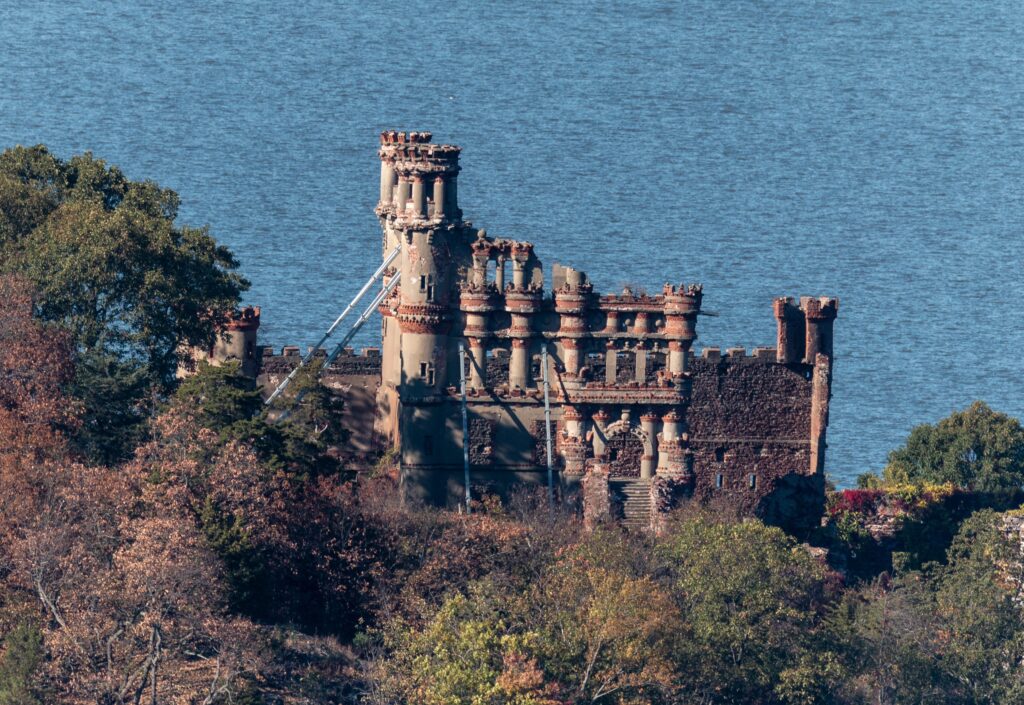
    This is one of Bannerman Castle in Beacon, NY.

    I took this in 2020 with the 70d and a $13,000, 800mm lens I borrowed from Canon. I was about a mile or two away.

    It’s hard not to love a lens like that.

    I used that same kit on its one:

    On the subject of borrowed lenses from Canon, I’ve got a fisheye lens coming on Monday. I have been waiting to use one of these lenses since I was in single digits, my brother got an AE-1, and I saw the opening to Hawaii Five O. It’s going be fun!

  • Walkin’ Around

    Just walking around on a gray day. Used my inexpensive 70-300 mm zoom cause it’s lighter than my 70-200.

    You can get good shots from an inexpensive lens. Just keep it clean and respect it as if it’s a $2,500 lens. It’ll love you back.


  • New Year, New Wine

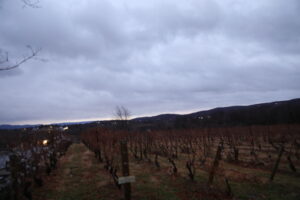
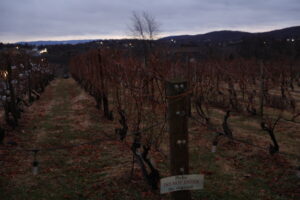
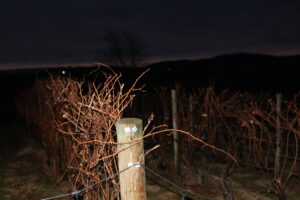
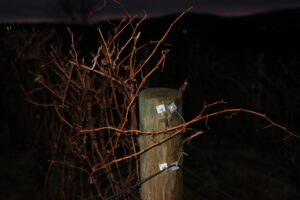
    We paid a visit to a friend’s winery today. As it turned out, our friend popped in to drop off a couple cases of bubbly for the tasting room.

    With the exception of a quick hello couple weeks ago at the gas station, we haven’t seen Matt in several months.

    He told us that he’s bee really busy in the cellar making wine because the volume of the harvest this year is more than 2007, 2008, and 2009 combined!

    Sleep well you awesome wine vines… You’ve earned it! See you at bud break in a couple months!

    Who are we kidding? We’ll pop in to check on you soon!

    Top 2 with the 5d and 24-70 with manual settings. Bottom 2 70D, 24-70, all auto settings and built-in flash.

    It was cloudy, as you see, and close to magic hour and the light changed quickly. I tried to shoot manually but I couldn’t get the 70D to do what I wanted.

    I know all the photo bloggers make a big deal about how you want “total, and complete artistic control from manual, man. You’re not a real photog, not a real artist unless you do!”

    Yeah, that’s bullshit.

    It’s like saying to a carpenter, “Uhhh ya know, dude, unless you’re pulling a nail from your teeth, putting that pointy bit down, swinging a hammer, hitting that nail on the head and repeating, you’re a not a real carpenter. Those nailguns are for phonies!”

    I know plenty of working professional photographers who will shoot automatic when working some gigs when they can’t find the light, or the light is changing too fast to keep up.

    It’s part of the tool, and I, as the artist, can use whatever feature on that camera I want to get the image I want. It is a choice.

  • Happy New Year

    Quick pics. May you have a happy, healthy, and fun new year.

  • Pa-Rum-Pa-Pa-Pum

    In my younger years, I was a drummer. I drummed a-ha-lot … until my mom sold her house, and I lost my practice space.

    By then, I had moved on to singing because I got tired of lugging gear around.

    Then, I became a DJ and Karaoke host with even more gear to lug.

    When I started my film production company, I named one of them Little Drummer Films.

    While I don’t drum much now, the lessons I learned from drumming constantly about timing and pacing live with me every day.

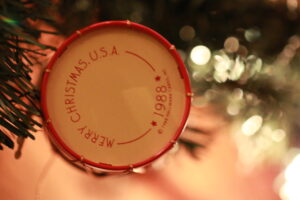
    Anyway, back when I was drumming every day, my mother gave me this ornament and several more like it.

    My lovely wife has turned them all into a beautiful drum garland we hang every year.

    Both shots were taken with the 100mm Macro lens, 5d is first, followed by the 70d.

  • Choo …

    As a native of the Philadelphia area and a lifelong Eagles fan, I was quite happy today when my Birds 1) beat the Cowboys, 2) clinched the #2 seed in the NFC, and 3) Saquon reached the 2,000-yard mark.

    So, in honor of my Birds, we’re taking a little train ride today.

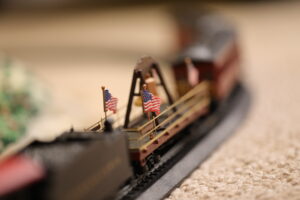
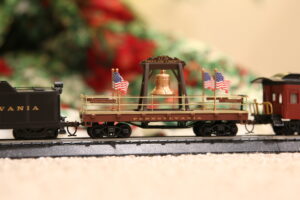
    A few years ago, maybe close to 30 now, I picked up a Bachmann limited edition train set that modeled the legendary Liberty Bell Special. For the past 10 years or so, every Christmas it has run under our Christmas tree.

    What’s the Liberty Bell Special?

    In 1915, the Liberty Bell went on tour. It traveled west to Seattle, then down to San Francisco, San Deigo, and back east across the southern routes, eventually returning home to Philadelphia.

    On 2015, during the 100th anniversary of the trip, Fred Klein of Trainweb wrote a great piece explaining the tip.

    So, here are some shots of that. I used my 100mm Macro lens on the 5dfor this first shot.

    5d with 100mm Macro
    70D with 24-70

  • Quat’ canards volant en l’air

    If your French isn’t up to snuff, that’s “Four ducks flying in the air” from the French version of the “12 Days of Christmas.”

    With this project, I’m finding that I use one camera to find the shot and then use the same settings on the other one. This is mainly to compare the two bodies and see how they do in the same circumstances.

    Technically, they say you get a full-frame shot with the 5D. All that means is it’s equivalent to something shot on 35mm film.

    The 70d is a crop sensor that doesn’t give you the same size image as a full-frame and increases the magnification on the lens.

    Those are general explanations, so if you disagree with what I’m writing, I’ll let you fester with that.

    Anyway, I’m sticking with this year’s tree again. It’s only going to be up for another week or something so, ya know.

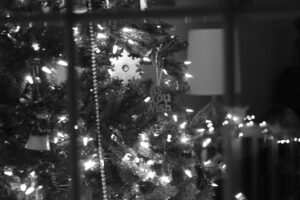
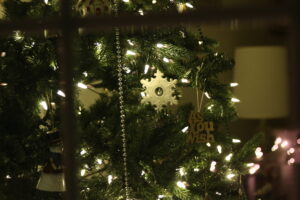
    The top shot is from outside using the 5d with the 24-70.

    The bottom two are the 70d with the 24-70 and a little closer.

    I think I mentioned that I’m shooting both RAW and JPEGs for this project simply for speed and ease of keeping on track. In the case of the JPEGs, there’s no external processing, just what the camera catches with the in-camera style settings. At some point, I may go back and process the RAW files but I have no plans for that at the moment.

    Anyway, the second shot is with the Monochrome in-camera style. The third is the, I think Fine style.